Smart Parking System: How It’s Transforming Urban & Commercial Parking
Every driver knows the feeling. You arrive at your destination on time, only to lose the next fifteen, twenty, sometimes thirty minutes circling the same three blocks, searching for a place to simply stop the car. It’s such a common experience that we’ve stopped questioning it — as if hunting for a parking spot is just an unavoidable tax on city living.
It isn’t. And technology proves that is a smart parking system.
What was once a niche innovation reserved for forward-thinking smart cities has become one of the fastest-growing categories in urban infrastructure. According to Grand View Research, the global smart parking systems market was valued at roughly $10.2 billion in 2025 and is projected to reach $53.4 billion by 2033 — a compound annual growth rate of over 23%. That’s not an incremental growth. That’s a category being rebuilt from the ground up, and it’s happening because the old way of managing parking simply doesn’t scale anymore.
This post breaks down what a smart parking system actually is, the technology powering it, and why it’s becoming a non-negotiable infrastructure for both city planners and commercial facility operators.
The Problem Smart Parking Was Built to Solve
Before getting into technology, it’s worth sitting up with the scale of the problem it solves.
In Indian metro cities, drivers lose up to 20 minutes per trip just searching for parking — adding up to roughly 7.5 days a year per driver, according to a Boston Consulting Group study on urban mobility. The Centre for Science and Environment estimates that as much as 30% of traffic congestion in Indian cities is directly caused by vehicles circling in search of a parking spot — not traffic heading somewhere, just traffic looking for somewhere to stop. Globally, the picture isn’t much different: research cited by GSMA found that deploying smart parking systems can cut the time drivers spend searching for parking by up to 43%, reduce vehicle miles traveled by 30%, and cut overall traffic volume by 8%.
This isn’t just a driver’s inconvenience. For facility operators, it translates into underused infrastructure, security blind spots, revenue leakage from manual ticketing and cash handling, and a constant operational headache of staff managing access points that were never designed to handle today’s vehicle volumes. For cities, it means more emissions, slower commutes, and parking infrastructure that consumes enormous amounts of valuable urban land — in some Indian metros, parking demand alone is estimated to require land equivalent to hundreds of football fields.
A smart parking system exists to close that gap between how much parking infrastructure a city or facility has, and how efficiently that infrastructure is being used.
What Exactly Is a Smart Parking System?
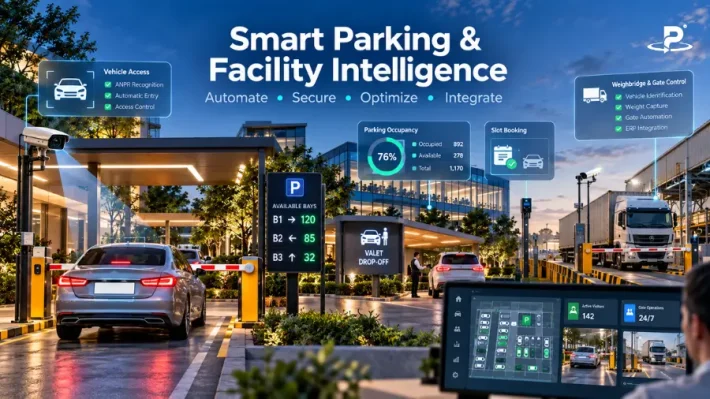
At its core, a smart parking system is the application of sensors, cameras, connectivity, and software to make parking infrastructure visible, measurable, and automated — instead of static and manually managed.
Traditional parking management relies on people: a guard checking vehicles at a gate, a cashier collecting payment, a driver guessing whether there’s space on level three. A smart system replaces guesswork with data. It knows, in real time, which spaces are occupied and which are free. It knows which vehicles are authorized to enter, and which aren’t. It can process payment without a human in the loop, and it can flag a security exception the moment it happens, rather than someone notices a problem hours later.
This shift sounds simple, but it changes the entire operating model of a parking facility — from reactive and manual to predictive and automated.
The Core Technologies Behind Smart Parking
A few technologies do most of the heavy lifting in any smart parking deployment and understanding them helps clarify why “smart parking” isn’t a single product but an ecosystem of interoperating components.
IoT sensors and occupancy detection
Ultrasonic or magnetic sensors installed at individual parking spaces, or cameras covering entire zones, continuously detect whether a space is occupied. This data feeds directly into live occupancy dashboards and digital signage, so drivers know where to go before they’ve even entered the building.
RFID-based access control
UHF RFID tags issued to registered vehicles allow a reader to detect and validate a vehicle several meters away — well before it reaches a barrier. The gate lifts automatically as the vehicle approaches, with no need to stop, scan a card, or interact with security staff. This is particularly well-suited to recurring traffic: tenants, employees, residents — anyone who needs frequent, low-friction access.
ANPR (Automatic Number Plate Recognition)
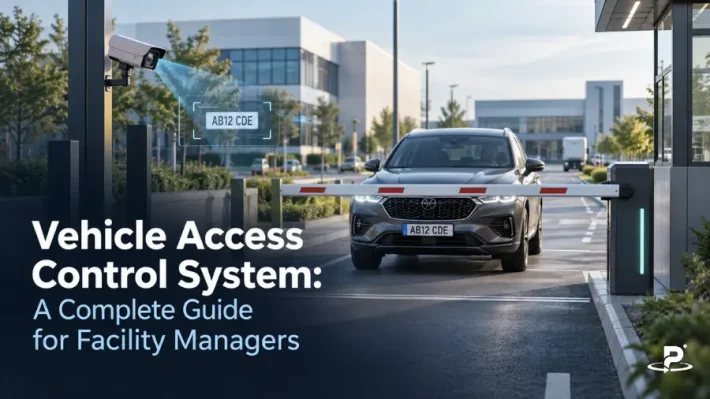
Cameras read a vehicle’s number plate directly, with no tag or device required on the vehicle itself. This makes ANPR ideal for visitor traffic, ad-hoc vehicles, and enforcement use cases, since it works on any vehicle that drives up — no pre-registration of hardware needed.
QR-based mobile access.
For pre-registered visitors, a QR code issued via SMS or a mobile app allows quick, auditable, one-time access — scanned by security or read automatically at the gate. It’s a lightweight way to extend controlled access to people who aren’t part of the regular vehicle pool.
Centralized software and dashboards.
All this hardware is only as useful as the software tying it together. A centralized platform aggregates entry/exit logs, live occupancy, alerts, and analytics across multiple gates and even multiple sites, giving facility managers one place to monitor and control an entire parking operation.
Automated boom barriers.
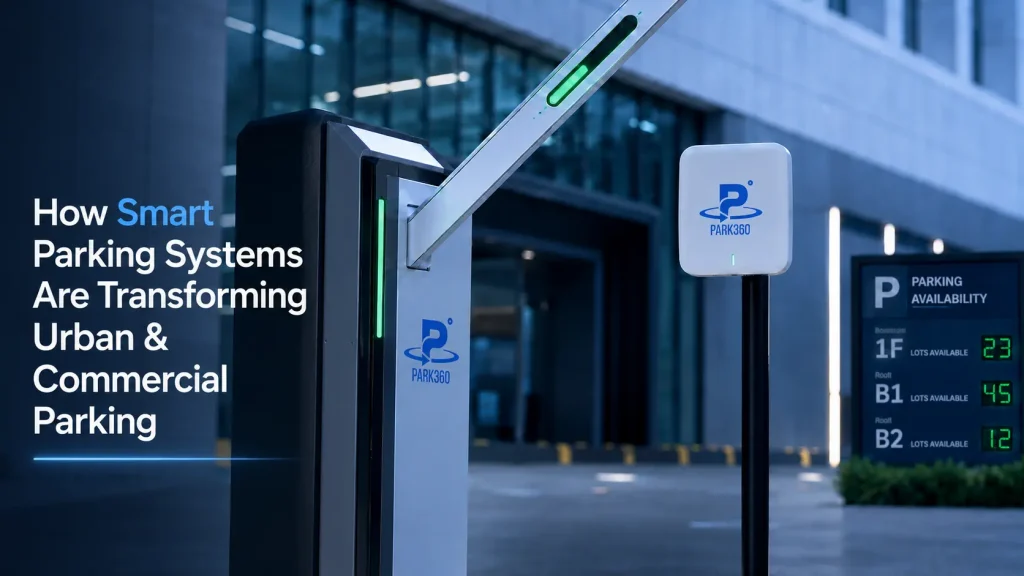
The physical layer — the barrier itself — is triggered automatically by validated RFID, ANPR, or QR events, removing the need for a person to manually operate it at every vehicle’s movement.
Individually, each of these technologies solves a piece of the puzzle. Combined, they form a system that can manage thousands of vehicle movements a day with minimal manual intervention.
How This Is Transforming Urban Parking
At a city level, smart parking is becoming a foundational piece of smart city infrastructure rather than an optional add-on. The European Commission reported that over half of EU cities with populations above 100,000 had implemented smart parking systems by 2023, with adoption targets climbing higher still. The UK’s Department for Transport found cities equipped with smart parking systems saw a 35% reduction in average time spent looking for parking. These aren’t marginal improvements — they represent a measurable change in how efficiently a city moves.
For municipal and public parking operators specifically, smart systems also solve a long-standing revenue problem. Manual fee collection is vulnerable to leakage — cash that goes uncollected, undocumented, or unaccounted for. Automated, system-driven ticketing and payment close to much of that gap, while also generating the kind of granular usage data that helps city planners make better decisions about where parking infrastructure is needed.
How This Is Transforming Commercial Parking
For commercial facilities — IT parks, corporate campuses, hospitals, malls, residential societies, industrial sites — the transformation is just as significant, even if the scale is different.
The most immediate impact is operational. A facility that once relied on a guard manually checking every vehicle at every gate can shift to a model where authorized tenant vehicles pass through automatically via RFID, visitors are pre-registered and granted QR-based access, and every single movement is logged with a timestamp and vehicle ID — without anyone needing to write anything down. That’s a fundamentally different security posture: instead of relying on a guard’s memory or a paper register, the facility has a complete, searchable audit trail of who entered, when, and through which gate.
The second major impact is space efficiency. Multi-level facilities can use live occupancy data and digital displays to direct drivers straight to available space — on the right level, immediately — rather than letting them discover availability by trial and error, floor by floor. For a large facility, this alone can meaningfully reduce internal traffic and the frustration that comes with it.
The third is integration. Modern smart parking platforms aren’t standalone tools — they connect with ERP systems, payment gateways, and visitor management platforms already in use at a facility. This means parking data doesn’t sit in a silo; it becomes part of a facility’s broader operational picture, useful for everything from compliance reporting to space planning.
And increasingly, this isn’t optional. As commercial real estate competes on tenant experience, a facility that still relies on manual gate operations and paper logs is visibly behind ones offering instant, contactless, fully automated access. The technology has shifted from a “nice to have” differentiator to a baseline expectation.
What’s Driving Adoption Right Now
A few forces are converging to accelerate smart parking adoption faster than almost any other category of building technology.
Rapid urbanization continues to push more vehicles into less available space — the UN projects that nearly 68% of the global population will live in cities by 2050, intensifying pressure on already-constrained parking infrastructure. Government-led smart city programs, from India’s Smart Cities Mission to similar initiatives across Asia and Europe, are directly funding intelligent transport and parking infrastructure as a policy priority. And on the commercial side, facility operators are under growing pressure to reduce operational costs while improving security and tenant experience simultaneously — a combination that manual, people-dependent parking operations simply cannot deliver at scale.
The Bottom Line
Smart parking isn’t a futuristic concept anymore — it’s an operating reality that’s already reshaping how cities and commercial facilities manage one of their most overlooked but high-friction resources. The shift from manual, reactive parking management to automated, data-driven systems aren’t just about convenience for drivers, though that matters too. It’s about security, revenue protection, space efficiency, and the kind of operational visibility that lets facility managers understand and improve how their infrastructure is used.
The facilities and cities investing in this shift now aren’t chasing a trend. They’re solving a problem that’s only going to get more expensive to ignore as vehicle ownership and urban density continue to climb.
This is precisely the gap PARK360 is built to close — bringing UHF RFID, ANPR, QR-based access, and real-time occupancy intelligence together into one integrated platform, so that parking infrastructure stops being a daily operational headache and starts being a managed, measurable system.
Curious what a smart parking system could look like at your facility? Get in touch with the PARK360 team to discuss your site.