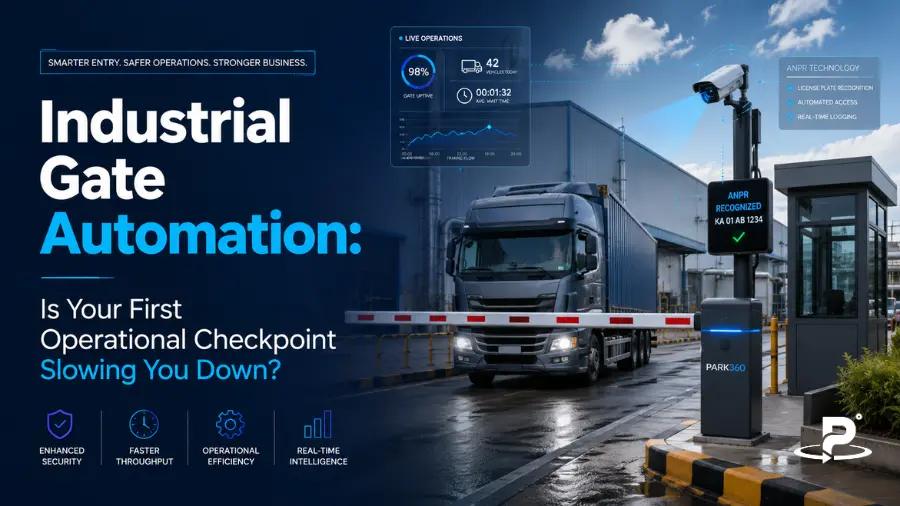
Industrial Gate Automation: Is Your First Operational Checkpoint Slowing You Down?
For an Operations Director in manufacturing, industrial logistics, warehousing, or heavy industry, every minute of operational delay has a measurable cost. That is why Industrial Gate Automation is no longer just a security upgrade — it is becoming a critical layer of operational efficiency, compliance, and real-time movement control.
You track OEE on the shop floor.
You monitor line efficiency.
You review shift productivity.
You scrutinize dispatch timelines.
Yet one of the most overlooked sources of daily operational loss may be sitting right at the perimeter of your facility.
Your industrial gate.
Most industrial facilities process dozens, sometimes hundreds, of truck movements, vendor visits, contractor entries, and dispatch exits every single day. When these movements are managed through manual registers, phone calls, guard-level judgment, and disconnected systems, the gate stops being a controlled access point.
It becomes a bottleneck.
That bottleneck does not just delay vehicles. It affects logistics efficiency, compliance readiness, manpower utilization, dispatch accuracy, and real-time operational visibility.
If you are still evaluating how gate operations affect logistics performance, this guide on how industrial gates improve logistics explains why the gate plays a much larger role in industrial movement than most facilities realize.
When Access Control Starts Slowing Operations
A gate becomes a bottleneck when every vehicle movement needs manual verification, phone calls, paperwork, or security-level judgment before it can proceed.
At that point, the gate is no longer just managing access. It is delaying dispatch, increasing compliance risk, consuming manpower, and reducing visibility into daily operations.
The problem is that these delays rarely look urgent in isolation. But across dozens or hundreds of truck, vendor, and contractor movements every day, they quietly become a measurable operational drag.
Here are five signs it is already happening at your facility.
1. Trucks Are Waiting Longer Than They Should
If inbound or outbound trucks are waiting 10, 20, or 30 minutes before clearance, your facility is absorbing a cost that should not exist.
Waiting time at the gate is not just a logistics inconvenience. It can lead to demurrage charges, delayed dispatches, disrupted production schedules, and vendors building extra buffer time into your facility’s movement cycle.
Manual gate processes are slow by design.
Paper logbooks.
Phone-based verifications.
Hand-operated boom barriers.
Manual vehicle number entries.
One guard coordinating multiple checks at once.
That is a single point of failure. Under high vehicle volume, it shows quickly.
Watch for these signs:
- Average truck turnaround time at entry exceeds 8 to 10 minutes
- Drivers regularly complain about clearance delays
- Dispatch teams add buffer time because of gate uncertainty
- Queues form during peak entry or dispatch hours
- Outbound vehicles wait even after loading is complete
If this is a recurring issue, it may be time to review whether your current setup needs an upgrade. This article on upgrading your industrial gate automation system covers when older gate systems start limiting operational performance.
2. Skilled Manpower Is Doing Work a System Could Handle in Seconds
Walk up to your gatehouse on a busy morning and observe what your security team is actually doing.
Data entry.
Phone calls to verify vendors.
Manual visitor logging.
Checking paper slips.
Printing and issuing passes.
Recording vehicle numbers repeatedly.
These are low-value administrative tasks, but they consume hours of productive manpower every day.
The real role of a security team should be exception handling, situational awareness, and incident response. Not manually writing vehicle numbers into a register for the fourth time in a week.
Every hour spent on manual gate administration is an hour not spent on higher-value security and operational control.
Watch for these signs:
- Gatehouse headcount feels higher than necessary
- Security staff spend more time on paperwork than monitoring
- Overtime is common in gate/security rosters
- Visitor and vehicle logs contain frequent errors
- The same data is entered multiple times in different places
Industrial gate automation helps shift routine validation from people to systems. Vehicles, contractors, vendors, and visitors can be logged, verified, and authorized digitally, while security teams focus only on exceptions.
3. Compliance Is Held Together by Memory, Not Process
Industrial facilities operate under strict requirements.
HSE standards.
ISO protocols.
Contractor induction requirements.
Permit-to-work validation.
Visitor records.
Vendor movement logs.
Vehicle entry and exit documentation.
When gate management is manual, compliance depends heavily on whether the right person follows the right process at the right time.
That is a fragile operating model.
A contractor may enter without valid induction.
A vendor vehicle may be cleared without a verified permit.
A visitor record may be missing during an audit.
A material movement may not be properly linked to authorization.
Each of these creates compliance exposure, and most of them are preventable.
Watch for these signs:
- Visitor or contractor logs are incomplete
- Timestamped entry records are difficult to produce
- Access is granted based on familiarity rather than verification
- Permit checks depend on phone calls or verbal approvals
- Audit preparation requires manual record reconstruction
A well-designed industrial gate automation system can enforce rules before access is granted. If a contractor induction is expired, the system can deny access. If a vendor is not pre-approved, entry can be held. If a vehicle is not mapped to a valid movement, the gate does not open.
For teams planning a structured automation roadmap, this industrial gate automation buying guide can help identify the key features, integrations, and evaluation criteria to consider before implementation.
4. Your Gate Data Is Always Late and Never Useful
If gate reporting is manual, you are always working with yesterday’s information.
Truck turnaround anomalies.
Throughput bottlenecks.
Unusual visitor patterns.
Vendor delays.
Peak-hour congestion.
By the time these show up in a spreadsheet, the opportunity to act has already passed.
This is why many operations teams rely on informal workarounds. WhatsApp messages. Phone calls to the gatehouse. Supervisor updates. Manual follow-ups.
The formal reporting system cannot tell them what is happening right now, so they depend on people.
That is a clear sign that the process has broken down.
Watch for these signs:
- Gate reports arrive hours after the shift ends
- Operations teams call the gatehouse for live updates
- There is no real-time queue or TAT visibility
- Gate efficiency is not included in operational reviews
- Management cannot see live vehicle movement across shifts
Modern industrial gate automation turns the gate into a real-time data source. Every entry, exit, hold, approval, rejection, and exception becomes visible through dashboards and alerts.
Instead of discovering problems after the shift, teams can act while the issue is still happening.
5. The Losses Never Show Up as a Line Item
This is the most dangerous part of manual gate operations.
The losses are real, but they are rarely visible.
A truck waits 18 minutes at the gate.
A contractor is delayed because clearance is manual.
A vendor is turned away because nobody can verify the permit quickly.
A dispatch vehicle waits even after loading is complete.
A security guard spends half the shift on manual entries.
None of these events appears as a separate line item in a monthly cost review.
They simply disappear into shift time.
But the cost compounds.
If your facility processes 40 truck movements a day and each vehicle loses an average of 12 minutes at the gate, that is more than 200 hours of logistics time lost every month. This does not include the downstream impact on production scheduling, manpower planning, loading bays, vendor coordination, and dispatch commitments.
Watch for these signs:
- No formal gate turnaround time tracking
- No gate efficiency metrics in operations reviews
- Manual delays are accepted as normal
- Dispatch teams build buffers around gate delays
- Nobody owns gate-level performance data
This is where industrial gate automation changes the conversation. It makes gate losses measurable. Once they are measurable, they become manageable.
The Gate Deserves the Same Intelligence You Apply Everywhere Else
Industrial facilities have already modernized many parts of their operations.
Production lines are monitored.
Warehouse movement is tracked.
ERP systems manage dispatch and inventory.
Weighbridges record vehicle loads.
Security systems monitor access.
But if the gate is still running on manual checks, the operation has a weak link at the first and last physical checkpoint.
PARK360’s Facility Intelligence platform treats the gate as what it actually is: your facility’s first operational checkpoint.
With PARK360, industrial facilities can bring together:
- ANPR-powered vehicle recognition
- Automated boom barrier control
- Digital contractor and vendor management
- Permit and induction verification
- Vehicle movement logs
- Real-time truck turnaround visibility
- Exception alerts
- Centralized dashboards
- Integration-ready access control workflows
Pre-authorized vehicles can be cleared quickly. Contractors can be verified before reaching the barrier. Security teams can focus on exceptions. Operations teams can monitor TAT, congestion, and gate movement in real time.
For a broader overview of how industrial gate automation systems operate, refer to the PARK360-powered Industrial Gate Automation System.
Manual Gate Delays Are Not Inevitable
None of the losses described above is unavoidable.
They are the predictable result of running a high-volume industrial operation through a manual gate process.
The good news is that every one of these losses is recoverable.
When the gate becomes automated, connected, and visible, it stops being a bottleneck and becomes a control layer.
That means faster vehicle movement, stronger compliance, better manpower utilization, live operational visibility, and fewer hidden losses across the facility.
Industrial gate automation is not just about opening and closing a barrier.
It is about making your first operational checkpoint intelligent enough to support the scale, speed, and accountability your facility already demands.