
Warehouse Material Theft: How the Duplicate Number Plate Heist Exposes Why You Can’t Trust Your Eyes
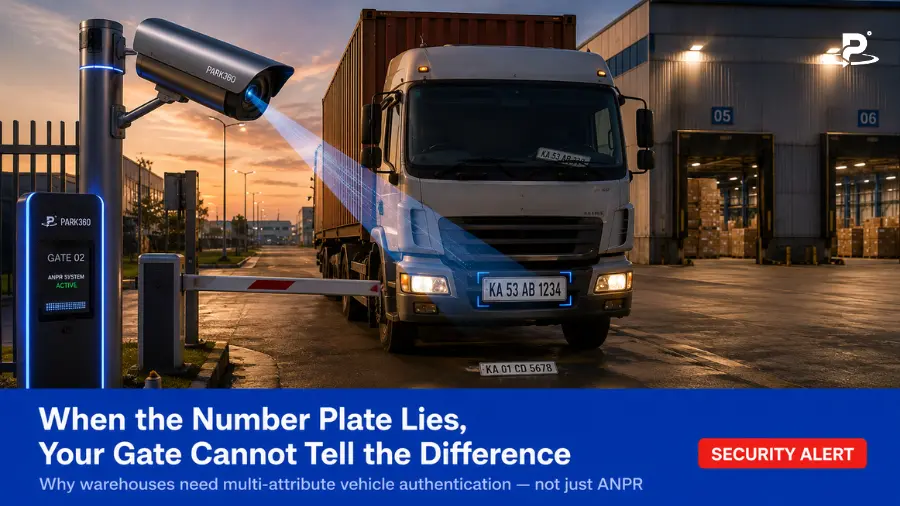
It began like any routine delivery day. A truck pulled up to the warehouse gate, displayed what appeared to be a valid number plate, and was waved through. Workers loaded the consignment. The truck exited without triggering a single alarm. Somewhere down the road — a few kilometres away — the number plate was swapped back to the vehicle’s original registration. By the time anyone realized what had happened, the truck, the plate, and the material were gone without a trace.
This is not a screenplay. This is a pattern that plays out across warehouses and logistics facilities in India with alarming regularity. And it exploits one of the most fundamental assumptions in gate security: that a number plate tells you who a vehicle is.
It does not.
The Anatomy of a Duplicate Plate Theft
The mechanics of this scheme are deceptively simple. Perpetrators identify a legitimate vendor or transporter who regularly enters a target facility. They clone or fabricate that vehicle’s number plate — a task that requires minimal resources and no technical expertise. They arrive at the gate during a busy operational window, blend into the normal flow of vehicles, and rely on a single point of verification: a security guard reading a number plate.
Once inside, they load material — sometimes with the help of insiders, sometimes simply by presenting the right paperwork that matches the plate on file. They exit. The legitimate vendor continues to make routine visits, entirely unaware their identity was borrowed. By the time the discrepancy surfaces during a stock audit or delivery reconciliation, days may have passed.
The investigation that follows hits an immediate wall. The exit footage shows a number plate that belongs to an innocent vehicle. The actual perpetrator’s plate is untraceable. CCTV has captured a ghost.
Why Traditional Gate Systems Fail
Most warehouses operate with a combination of physical security personnel, entry registers, and basic CCTV. Some have moved to boom barriers or access cards for personnel. But vehicle entry — particularly for inbound logistics, contract haulage, and vendor deliveries — remains dangerously under-authenticated.
The core failure is single-point identity verification. When a number plate is the only credential a vehicle presents, and that plate is verified only visually or logged manually, the system has no mechanism to detect a duplicate. It cannot distinguish between a registered plate and a fabricated one. It cannot cross-reference whether the physical description of the vehicle matches the registered vehicle. It cannot flag that the same plate is appearing on a different truck model, a different colour, or a chassis that does not match historical records.
In a facility processing dozens to hundreds of vehicle movements per day, that gap is a standing invitation.
What Intelligent Vehicle Authentication Actually Requires
Closing this vulnerability demands layered verification — not just plate reading, but plate reasoning.
ANPR-based systems at the gate level can capture number plates automatically and match them against pre-registered vehicle databases in real time. But the critical upgrade is multi-attribute vehicle fingerprinting: cross-checking the plate against the vehicle’s make, model, colour, and body type simultaneously. A white container truck registered against a blue light commercial vehicle should never pass authentication — regardless of what the plate says.
Beyond that, trip-based vehicle authorization adds another layer: the vehicle is not simply recognized, it is expected. A truck that arrives outside its scheduled window, or without a corresponding inbound material order tied to its plate, is flagged before it reaches the loading bay. Unscheduled vehicle arrivals are one of the clearest behavioral signals of an illegitimate entry attempt.
Material movement tracking at the gate — capturing what leaves the facility against what was authorized to leave — creates a reconciliation loop that can surface discrepancies in near real time rather than days later during a manual audit.
When these systems work in concert, the vulnerability a duplicate plate exploits — the gap between visual identity and verified identity — is effectively closed.
The Broader Operational Truth
This type of theft does not only cause direct material loss. It erodes vendor trust, disrupts supply chain integrity, and in severe cases implicates innocent transporters whose plates were cloned. The reputational and investigative costs frequently exceed the value of what was stolen. And because the method is replicable at low cost, a single successful operation often encourages repeat attempts at the same or similar facilities.
The question warehouse operators must ask is not whether this can happen to them. It is whether their current gate infrastructure would give them any evidence if it already had.
Conclusion
A number plate is not an identity. It is a label — one that can be copied, fabricated, and discarded in minutes. Facilities that treat plate recognition as the endpoint of vehicle authentication are operating with a known and exploitable gap in their security posture.
The incidents described here are not edge cases. They are the predictable outcome of under-authenticated access in high-throughput material environments. Closing that gap requires moving from visual verification to intelligent, multi-attribute vehicle authentication — systems that do not just read what a vehicle presents, but verify whether what it presents is consistent, expected, and legitimate.
Operational security at the gate is not a checkpoint. It is an intelligence function. It is time to treat it as one.