
5 Signs Your Facility Needs a Parking Enforcement System (And What’s at Stake If You Ignore Them)
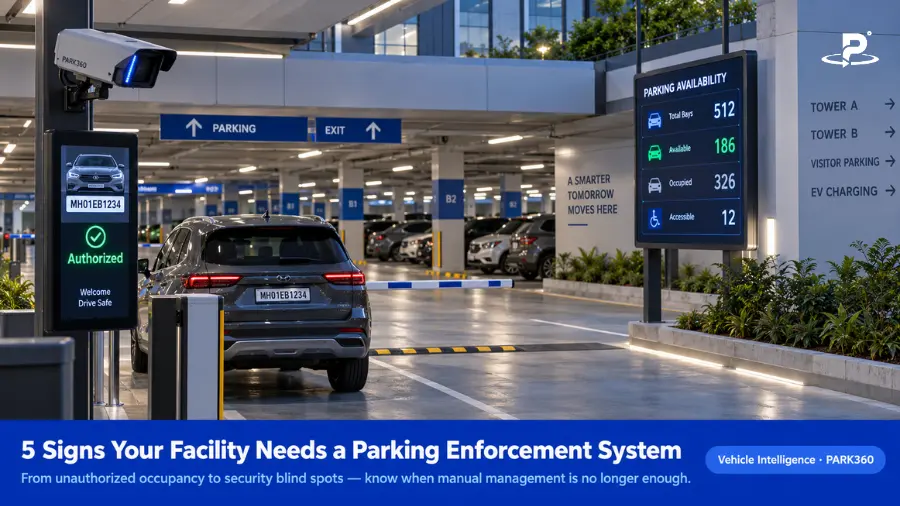
Parking seems like a straightforward operational problem — until it isn’t. For facility managers and operations leaders overseeing large campuses, industrial sites, or commercial properties, unmanaged vehicle movement quietly erodes efficiency, security posture, and the experience of everyone who walks through your gates.
The challenge is that parking dysfunction rarely announces itself dramatically. It accumulates — in unauthorized vehicles occupying reserved bays, in security blind spots at entry points, in complaints that pile up week after week. By the time leadership takes notice, the problem has already calcified into an operational norm.
Here are five concrete signs that your facility has outgrown manual parking management — and why the cost of inaction is higher than most organizations calculate.
1. Reserved Zones Are Regularly Occupied by Unauthorized Vehicles
If your designated bays — executive parking, accessible spaces, loading zones, or vendor-specific areas — are routinely taken by unauthorized vehicles, you have an enforcement gap, not just a courtesy problem. Manual checks by security personnel are inconsistently applied, easily contested, and resource-intensive. The downstream impact is real: delayed deliveries when loading bays are blocked, operational friction when VIP or executive bays are unavailable during critical visits, and a general erosion of rule-based discipline on the premises.
A structured parking enforcement system uses camera-based vehicle authentication, bay-level occupancy detection, and automated alerts to enforce zone rules in real time — without requiring personnel to physically patrol every section.
2. You Have No Reliable Data on Vehicle Dwell Times or Turnover Rates
How long does the average vehicle occupy a bay in your visitor parking zone? What percentage of your lot is occupied at peak hours versus off-peak? Which areas are chronically underutilized?
If your answer to any of these questions is “we don’t know” or “roughly,” your parking operation is running blind. Without dwell time data, you cannot identify overstaying vehicles, optimize bay allocation, or make evidence-based decisions about expanding capacity — or discovering you don’t need to. Organizations that implement occupancy analytics frequently find that their perceived parking shortage is actually a distribution problem: the wrong spaces are full while the right ones remain empty.
3. Security Cannot Verify Vehicle Credentials at Entry in Real Time
A visitor arrives in an unregistered vehicle. A contractor drives in on an expired access permit. A former employee’s vehicle enters using a credential that was never deactivated. In facilities relying on manual checks or basic barrier systems, these scenarios pass through without detection — and without a record.
ANPR (Automatic Number Plate Recognition) integrated with a structured enforcement framework changes this equation. Vehicles are authenticated against pre-registered lists, flagged in real time for mismatches, and logged with timestamps and images. This is not just about parking — it is a security layer that protects the entire facility perimeter.
4. Visitor Parking Generates Disproportionate Complaints and Confusion
Visitor experience begins at the gate. If visitors routinely report difficulty finding assigned bays, confusion about where to park, or confrontations with security over unclear rules, your parking infrastructure is actively damaging your organization’s professional image.
In corporate campuses, hospitals, hotels, and commercial properties, visitor parking experience is a measurable KPI — even if most facilities don’t track it. Parking guidance systems with real-time bay availability, combined with pre-registered visitor vehicle management, eliminate ambiguity and reduce the time visitors spend navigating before they even reach reception.
5. Enforcement Is Person-Dependent and Inconsistently Applied
If your enforcement outcomes depend on which security officer is on shift, you do not have a system — you have a policy that may or may not be followed. Person-dependent enforcement creates liability exposure, inter-departmental friction, and a culture where parking rules are treated as suggestions rather than operational requirements.
Systemized enforcement removes the human inconsistency variable. Rules are applied uniformly — bay restrictions, time limits, zone authorizations — and violations are documented automatically. This also relieves security personnel to focus on higher-value tasks rather than manual parking patrol.
Conclusion
None of these signs are isolated inconveniences. Together, they indicate that your vehicle movement operations lack the structure, visibility, and intelligence required to run a facility at scale. The cost of maintaining the status quo compounds over time: wasted security labor, unresolved access risks, visitor friction, and decisions made without reliable data.
A parking enforcement system is not a luxury upgrade — it is operational infrastructure. For facility managers and operations leaders who are accountable for both security and efficiency, the question is not whether to implement one. It is how quickly you can stop absorbing costs that a structured system would have prevented.