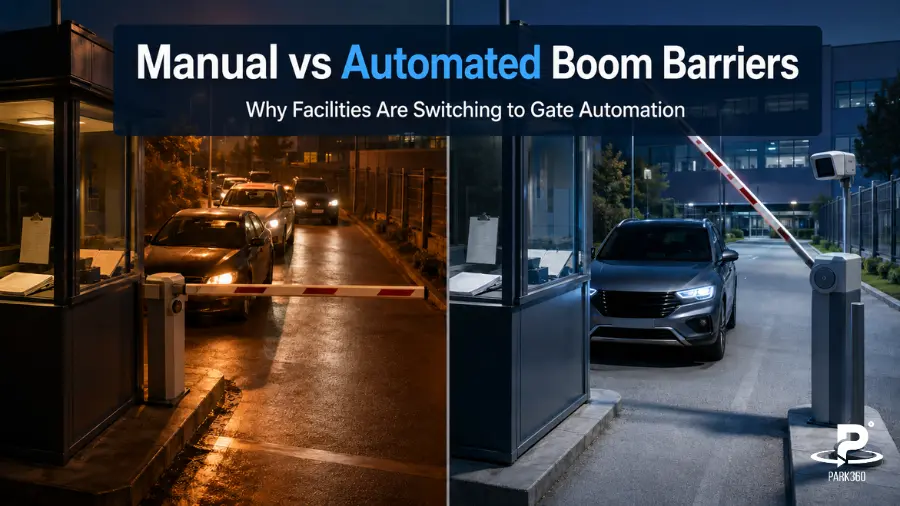
Manual vs Automated Boom Barriers: The Revolutionary Shift to Safer, Faster Gate Automation
A boom barrier may look like a simple piece of hardware, but in high-traffic facilities, it directly influences entry speed, security control, manpower dependency, visitor experience, and operational visibility.
Every vehicle movement at a facility begins at the gate. For years, manual boom barriers were considered sufficient for that job. A guard operated the barrier, checked vehicle details, noted entries in a register, and the process moved on. For small facilities with predictable, low-volume traffic, this worked well enough.
But the nature of the facilities has changed. Vehicle volumes have increased. Security expectations have risen. Visitor traffic has grown more complex. Delivery and vendor movement has expanded. Facilities — corporate campuses, hospitals, residential societies, malls, and industrial plants alike — are now managing hundreds or thousands of vehicle movements every single day.
In this environment, the manual approach reveals its limits quickly. Guards become bottlenecks. Registers become incomplete. Records become unverifiable. And the gate — which should be a control point — becomes a source of delays, security gaps, and operational frustration.
This is why automated boom barriers are increasingly becoming the standard across commercial, industrial, institutional, and residential facilities. The real question is no longer whether your facility needs a boom barrier. The question is whether a manual boom barrier is still enough.
What Is a Manual Boom Barrier?
A manual boom barrier is a gate control system operated by a security guard or gate operator. The barrier may be lifted manually or activated through a basic switch or control panel by the person on duty.
Vehicle verification in a manual system typically relies on visual inspection, physical ID cards, windshield stickers, paper-based passes, written registers, or phone calls to confirm access. Once the guard is satisfied, the barrier is opened and the vehicle is allowed to enter or exit.
Where Manual Boom Barriers Are Commonly Used
Manual boom barriers are commonly found in small standalone offices, low-volume residential societies, temporary event access points, basic parking lots, small warehouses, and local commercial buildings where vehicle traffic remains limited and predictable.
Why Facilities Still Use Manual Boom Barriers
There are genuine reasons why facilities continue to use manual boom barriers. The initial cost is lower, installation is straightforward, no complex software is required, and security teams are already familiar with the process. For locations with very low traffic and basic security needs, a manual barrier can still be a functional choice. The problem arises when vehicle volume, visitor complexity, or security requirements begin to grow beyond what a person at the gate can reliably manage.
What Is an Automated Boom Barrier?
An automated boom barrier is a motorized gate control system that manages vehicle entry and exit using integrated access control technology. Instead of relying on a guard’s judgment and manual verification, the system automatically validates the vehicle or visitor and triggers the barrier based on the outcome.
Automated boom barriers can be integrated with a wide range of technologies depending on the facility’s requirements — RFID and UHF readers for tag-based vehicle identification, ANPR cameras for number plate recognition, QR code scanners for visitor access, FASTag readers for contactless identification, mobile app-based authorization, ticketing and payment systems for paid parking, visitor management platforms, and centralized dashboards that give operations teams real-time visibility across every gate.
Automated boom barriers are not just about opening the gate faster. They create a controlled, digital, and auditable access layer for every vehicle entering or exiting the facility. Every movement is logged. Every exception is recorded. And every gate event becomes part of a traceable, searchable operational record.
Common Technologies Used with Automated Boom Barriers
Depending on the facility type and access requirements, automated boom barriers are typically powered by one or more of the following: RFID and UHF tags for recurring vehicles such as employees and residents, ANPR cameras for number plate-based identification, QR codes for pre-registered visitor access, FASTag-based identification for specific access workflows, mobile app authorization for remote approvals, ticketing and payment systems for commercial parking operations, and security control room integrations for centralized monitoring and response.
Manual vs Automated Boom Barriers: Quick Comparison
The difference between manual and automated boom barriers becomes clearest when placed side by side.
| Parameter | Manual Boom Barrier | Automated Boom Barrier |
| Operation | Guard-operated or manually controlled | System-controlled with automatic validation |
| Speed | Slower during peak hours | Faster and consistent |
| Security | Depends on guard judgment | Rule-based and digitally logged |
| Manpower | High dependency | Lower dependency |
| Visitor Handling | Manual entries and phone calls | QR, pre-registration, digital approval |
| Vehicle Logs | Paper registers or spreadsheets | Automatic digital records |
| Integration | Limited or none | RFID, ANPR, FASTag, VMS, parking systems |
| Revenue Control | Manual ticketing and payment risk | Better transaction and entry-exit reconciliation |
| Scalability | Limited | Suitable for high-volume operations |
| Visibility | Low | Real-time dashboards and reports |
Manual boom barriers may work when vehicle movement is limited. But once a facility starts handling recurring vehicles, visitors, vendors, delivery vehicles, paid parking, or multiple entry-exit points, automation becomes less of a luxury and more of an operational necessity.
Why Manual Boom Barriers Start Becoming a Bottleneck
Manual gates depend entirely on human attention. When traffic is low, this is manageable. When traffic peaks — during morning shift changes, lunch hours, hospital visiting hours, or mall weekends — the guard becomes the bottleneck.
Every vehicle requires some form of verification. That may mean checking a windshield sticker, matching a registration number against a list, calling an internal extension, writing vehicle details in a register, or issuing and collecting a paper pass. Each step adds time. During peak hours, these small delays compound quickly.
The problem is further compounded by the unpredictability of human attention under pressure. A busy guard managing peak traffic may skip verification steps. An unfamiliar vehicle may be waved through. A register entry may be missed. A shift handover may leave gaps in records. These are not failures of individual people — they are the structural limitations of a system that asks humans to perform fast, accurate, repetitive tasks at scale, consistently, across hundreds of interactions every day.
The Hidden Cost of a Slow Gate
A manual boom barrier rarely fails dramatically. Instead, it creates small delays repeatedly. A few seconds per vehicle during normal hours becomes several minutes during peak traffic. Across hundreds of vehicles a day, that delay becomes a measurable operational cost — vehicle queues forming outside the facility, employees arriving late to their desks, delivery windows being missed, visitor frustration at the front entrance, engines idling and fuel being wasted, and security gaps that only become visible when something goes wrong.
Beyond immediate friction, manual systems offer virtually no operational visibility. Facility managers have no real-time data on how many vehicles are currently inside, which gate is congested, how long vehicles have been waiting, or whether any access violations have occurred. Problems surface through complaints, not through data. For facilities considering a more controlled approach, reviewing an industrial gate automation system guide can help clarify what a better access environment looks like before committing to a solution.
Why Facilities Are Switching to Automated Boom Barriers
The shift from manual to automated boom barriers is not driven by technology enthusiasm. It is driven by operational necessity. Here is what a gate automation system actually delivers when deployed correctly.
1. Faster Vehicle Entry and Exit
Automated validation removes the waiting time associated with manual verification entirely. RFID and UHF systems detect and validate a vehicle several meters away as it approaches, opening the barrier before the vehicle even reaches the gate arm. ANPR cameras read number plates in under a second. QR code access allows pre-registered visitors to enter with a single scan. The gate responds to the system, not to the pace of a guard’s workflow — which means access speed is consistent across every hour of the day, including peak hours.
2. Reduced Manpower Dependency
When the gate automation system handles verification, security teams no longer spend their shifts manually checking every vehicle. Guards can redirect their attention to exceptions — unfamiliar vehicles, suspicious activity, access disputes, incidents — rather than repeating the same verification sequence hundreds of times a day. This does not eliminate the role of security staff; it makes them more effective by focusing their attention on situations that genuinely require human judgment.
3. Better Access Control
Automated boom barriers operate on rules, not judgment. Only vehicles that are authorized get through. Access can be restricted by vehicle type, entry category, time of day, gate location, or validity period. Vehicles that are blacklisted, expired, or unregistered are blocked automatically. There is no scope for a guard to wave through a familiar face that should not have been allowed for entry. The access decision is made by the system, consistently, every time.
4. Real-Time Visibility
A centralized dashboard gives facility managers live visibility into gate activity — which vehicles have entered, which have exited, how many are currently on the premises, which gates are experiencing high volume, and what exceptions have occurred. This transforms gate operations from an operational blind spot into a real-time data source, enabling faster decision-making, better security response, and more accurate planning for staffing, parking allocation, and facility management.
5. Better Visitor and Customer Experience
For visitors, the automated gate experience is noticeably faster and more professional than waiting at a manual checkpoint. A pre-registered visitor arriving with a QR code on their phone moves through the gate in a matter of seconds. There is no waiting for the guard to make a verification call, no queue forming while a register is filled in, and no confusion about access permissions. For facilities where first impressions carry weight — corporate headquarters, premium residential societies, hospitals — this difference is a direct reflection on the quality of the facility itself.
6. Stronger Audit Trail
Every entry and exit event in an automated gate access control system is timestamped, logged against a vehicle record, and stored in the platform. This creates a complete, searchable, and tamper-resistant audit trail that is valuable for security reviews, dispute resolution, compliance documentation, and facility audits. A paper register cannot offer the same completeness, retrieval speed, or reliability under scrutiny.
7. Revenue Protection in Pay-and-Park Facilities
For facilities operating paid parking, manual ticketing and cash collection are inherently prone to leakage — tickets that are not issued, payments that are not collected, or transaction records that are incomplete. Automated boom barriers integrate directly with parking management systems, ensuring that every vehicle entry triggers a ticket record, every exit is reconciled against a payment, and every transaction is captured in a verifiable log. This closes the gap between vehicles that enter and revenue that is collected.
Where Automated Boom Barriers Create the Biggest Impact
Corporate Campuses and IT Parks
Corporate facilities benefit from RFID or UHF-based access for employees, QR-based entry for visitors, and ANPR-based verification for vendor and contractor vehicles. Automated systems also support reserved parking allocation, department-level access rules, and coordinated control across multiple gates on large campuses — removing the need for guards at every entry point.
Residential Societies and Gated Communities
Residents use RFID tags for seamless daily entry and exit. Visitors are pre-registered through a mobile app and arrive with a QR code that clears them at the gate without manual intervention. Delivery and service vehicles are managed through temporary digital passes. Every vehicle movement is logged against a flat or unit number, giving society management a complete, real-time record of who is on the premises.
Shopping Malls and Commercial Complexes
High footfall and heavy parking demand make manual gate operation impractical at commercial scale. Automated boom barriers connect with ticketing and payment systems, manage occupancy across multiple parking levels, and provide operators with live data on space availability, peak-hour patterns, and revenue reconciliation.
Hospitals
Hospital access involves multiple categories of vehicles with different priority levels. Ambulances and emergency vehicles require immediate, unrestricted access. Doctors and staff need fast, uninterrupted daily entry. Visitors require controlled, logged movement. Automated boom barriers manage all of these simultaneously — applying the right access rule to each vehicle category without requiring a guard to make that distinction manually during a busy shift.
Industrial and Logistics Facilities
Industrial gate automation addresses the operational complexity of managing truck movement, vendor authorization, contractor entry, material dispatch, and weighbridge compliance. Understanding how industrial gates improve logistics efficiency is important for facility managers evaluating this upgrade. Automated systems connect with ERP workflows, ensuring vehicle movement is tied to delivery schedules, load verification, and compliance documentation in a single traceable record.
Airports, Events, and Public Parking Facilities
Large-volume public facilities require automation as a baseline requirement, not an enhancement. Multiple gates, high simultaneous entry and exit rates, paid parking management, access segmentation across vehicle categories, and the need for centralized control make manual gate management operationally unsustainable at this scale. Gate automation systems provide the speed, consistency, and real-time visibility that these environments demand.
Key Technologies That Power Automated Boom Barriers
RFID and UHF-Based Boom Barrier Access
RFID-based vehicle access is the most efficient solution for recurring vehicles — employees, residents, tenants, and registered fleet vehicles. The vehicle carries a tag, the reader detects it from several meters away, and the barrier opens without the vehicle needing to stop. UHF systems extend the read range further, making them well-suited to wide entry lanes and faster vehicle approach speeds. The main requirement is that each vehicle must carry a physical tag, which involves initial issuance, occasional replacement, and ongoing management.
Best for: Employees, residents, tenants, fleet vehicles Key advantage: Fastest access, no stop required, reliable for repeated daily use
ANPR-Based Boom Barrier Access
ANPR-based vehicle access uses cameras to read number plates directly, with no hardware required on the vehicle itself. This makes it valuable for visitor management, enforcement use cases, and facilities that need to build a complete vehicle movement record without issuing physical tags. ANPR also supports automatic blacklisting and whitelisting and generates entry-exit logs tied to a plate number rather than a tag ID. Installation quality — camera placement, lighting conditions, coverage angle — directly affects system accuracy.
Best for: Visitor vehicles, enforcement, ad-hoc access, premium facilities Key advantage: No vehicle hardware needed, automatic vehicle record
QR-Based Visitor Boom Barrier Access
QR code access is the most practical solution for one-time or pre-registered visitors. A code is issued digitally — via SMS or a visitor management system — and scanned at the gate upon arrival. It is fast to generate, straightforward to revoke, and produces a clear per-visit audit trail. It is not designed for high-frequency daily access, but as a visitor access mechanism, it is low-infrastructure, low-cost, and highly effective.
Best for: One-time visitors, pre-approved guests, event attendees, contractors’ Key advantage: Easy to issue and revoke, no vehicle hardware required
FASTag-Based Boom Barrier Access
FASTag-based access uses the contactless identification infrastructure already familiar to highway toll operations. In specific parking and access control scenarios, it enables smooth, contactless vehicle identification without additional hardware on the vehicle beyond what most Indian vehicles already carry. It is particularly relevant for facilities looking to align their access workflow with the existing vehicle identification ecosystem, reducing the friction of issuing separate tags to regular users.
Best for: High-frequency vehicle movement, specific contactless access workflows Key advantage: No additional vehicle hardware, familiar ecosystem
Manual vs Automated: Which One Should You Choose?
The right choice depends on your facility’s operational profile, not on technology preference.
Choose a manual boom barrier if your facility handles very low vehicle volume, security requirements are basic, visitor traffic is minimal, digital vehicle records are not a priority, and cost is the primary deciding factor. For small, static properties where traffic is unlikely to grow significantly, a manual system remains a reasonable operational choice.
Choose automated boom barriers if your facility handles regular employee or resident traffic, receives visitors and vendors, operates paid parking, requires digital vehicle logs, needs real-time visibility into gate activity, or plans to expand across multiple gates or sites. Automated gate access control is also the right choice if security accountability, audit trails, or integration with parking or visitor management systems is a requirement.
For most modern facilities, the decision is not really between manual and automated gates. It is between short-term cost saving and long-term operational control. As vehicle volumes grow and expectations around security accountability and operational data rise, the cost of maintaining a manual gate typically exceeds the investment required for automation — not immediately, but consistently over time.
What to Check Before Upgrading to an Automated Boom Barrier System
Before selecting a gate automation system, facility managers should assess several operational and technical factors to ensure the right solution is deployed for the right environment.
Start with the basics: daily vehicle volume, peak-hour traffic patterns, the number of entry and exit lanes, and the types of vehicles the facility handles — passenger cars, two-wheelers, delivery trucks, ambulances, or a mix of all of these. Then define the access categories — employees, residents, visitors, vendors, contractors — and what rules apply to each category at each gate.
Next, assess integration requirements. Does the facility need visitor pre-registration? Is paid parking in scope? Will the system need to connect with an ERP platform, HR system, or building management software? Does the control room need a live dashboard, or is scheduled for reporting sufficient? Are there offline functionality requirements for periods of network downtime?
Finally, evaluate the physical infrastructure: power availability at gate locations, network connectivity, space for hardware installation, and whether the gate design can accommodate the chosen access technology without requiring significant civil work.
For facilities that handle heavy vehicle movement, vendor management, or ERP-linked logistics operations, working through a dedicated industrial gate automation buying guide before finalizing a system is a useful step that prevents mismatches between procurement and operational reality.
Questions Facility Managers Should Ask
Before committing to an upgrade, clarity on the following questions will significantly improve the outcome:
- Do we need RFID, ANPR, QR, FASTag, or a combination of access technologies?
- Do we need real-time dashboards accessible to the operations team and security?
- Should visitor pre-registration and management be integrated with gate access?
- Do we need payment system integration for paid parking?
- Will the system operate reliably during network downtime?
- Can it scale to additional gates or multiple facility locations?
- Who will manage access permissions, user records, and blacklists on an ongoing basis?
- What reports does the operations team need, and how frequently?
How PARK360 Helps Facilities Automate Gate Operations
PARK360 provides intelligent gate automation and vehicle access management for facilities that need more than a barrier connected to a single reader. The platform supports multiple access technologies — RFID and UHF-based vehicle access for recurring users, ANPR-based vehicle recognition for visitor and enforcement scenarios, QR-based visitor access for pre-registered guests, and FASTag-enabled workflows for specific access use cases. These are not offered as standalone tools. They operate as part of a connected platform that ties gate events to parking management, visitor workflows, occupancy data, and operational reporting.
PARK360 Gate Automation Capabilities
PARK360’s gate automation layer covers automated boom barrier integration, RFID and UHF vehicle access control, ANPR-based vehicle recognition, QR visitor access, FASTag-enabled access workflows, real-time entry and exit logs, visitor and contractor access management, parking management integration, live occupancy visibility, pay-and-park transaction support, centralized multi-gate and multi-site dashboards, role-based access controls, exception alerts, and scheduled operational reports.
PARK360 helps facilities move from guard-dependent gate control to a connected, automated, and visible access management environment. Whether the requirement is employee parking access at a corporate campus, visitor entry management at a residential society, industrial vehicle movement at a logistics hub, or public paid parking at a commercial complex, PARK360 enables facilities to select the right access technology for each use case and manage it through a single operational platform — rather than through a collection of disconnected hardware and manual workarounds.
Final Thoughts: Gate Automation Is No Longer Optional for High-Movement Facilities
Manual boom barriers still have a role. For small, low-traffic properties with basic security needs and no requirement for digital records, a guard-operated barrier can remain a practical and cost-effective solution.
But for facilities where vehicle movement is frequent, access categories are varied, security accountability is expected, and operational data matters — the manual gate has reached its functional ceiling.
Automated boom barriers improve gate speed, reduce manpower dependency, strengthen access control, create accurate digital records, and give facility managers the visibility they need to run gate operations efficiently and without blind spots. The gate is the first physical checkpoint every vehicle encounters at a facility. It should be as intelligent, consistent, and accountable as the rest of the facility it protects.
Facilities are switching to automated boom barriers because the gate has become too important to manage manually. When automated correctly, it stops being a bottleneck and becomes what it was always meant to be: a control point — precise, traceable, and built for the operational demands of a modern facility.
Looking to upgrade from manual boom barriers to an automated gate access control system? Connect with PARK360 to explore the right gate automation setup for your facility.
Frequently Asked Questions
What is the difference between a manual boom barrier and an automated boom barrier? A manual boom barrier is operated by a person, while an automated boom barrier opens and closes based on access validation through RFID, ANPR, QR code, FASTag, access cards, or software-based authorization — without manual intervention at the gate.
Are automated boom barriers suitable for residential societies? Yes. Automated boom barriers are well-suited to residential societies because they manage resident vehicle access, visitor QR entry, delivery of vehicle control, and security logs more efficiently and reliably than manual systems.
Which technology is best for automated boom barriers? It depends on the use case. RFID or UHF is best for recurring vehicles such as employees and residents. ANPR works well for vehicle recognition, visitor management, and enforcement. QR codes are ideal for pre-registered one-time visitors. FASTag supports specific contactless access workflows.
Do automated boom barriers reduce manpower requirements? Yes. Automated boom barriers handle repetitive verification and data logging automatically, allowing security teams to focus on exceptions, monitoring, and incident response rather than manually checking every vehicle.
Can automated boom barriers be integrated with parking management systems? Yes. Automated boom barriers can be integrated with parking management systems, visitor management platforms, payment systems, ANPR cameras, RFID readers, ERP systems, and real-time dashboards.
Are automated boom barriers useful for industrial facilities? Yes. Industrial facilities benefit from automated boom barriers for managing truck movement, vendor and contractor access, material dispatch tracking, compliance logs, and gate turnaround time — often integrated with weighbridge and ERP workflows.
Is gate automation expensive? The cost depends on the number of gates, the access technologies selected, software requirements, integrations, and support expectations. For high-traffic facilities, the long-term operational savings from faster vehicle movement, reduced manpower dependency, better revenue control, and improved security accountability typically justify the investment.